


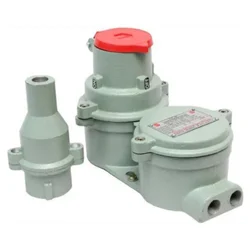
 Sockets
In most industrial setups, sockets are treated as utility hardware, something standard, replaceable, and often overlooked.
But in hazardous environments, that assumption creates a blind spot.
Because the truth is, power distribution doesn’t fail at the source; it fails at the interface.
This is where the explosion proof socket becomes far more than a product. It becomes a control point for risk, uptime, and compliance.
And this is the space where FCG Flameproof Control Gears (India) Pvt. Ltd. is not just supplying equipment but shaping how industries approach electrical safety at scale.
Shift the Perspective: From Product to Power Strategy
Instead of asking, “Which socket should we use?” high-performing facilities in 2026 are asking:
- How safe are our connection points under load?
- Can our sockets handle repeated operations without degradation?
- Are we audit-ready across all hazardous zones?
- Can we scale power distribution without redesigning infrastructure?
An explosion proof socket answers all of these when it is engineered as part of a larger system design, not as a standalone item.
Where the Real Complexity Lies
India’s industrial growth is no longer linear; it’s clustered, dense, and hyper-operational.
In Gujarat
Facilities in Ahmedabad, Vadodara, Ankleshwar, and Vapi operate with continuous chemical flows, where sockets are exposed to corrosive vapors and frequent washdowns.
In Hyderabad
Bulk drug manufacturing units run non-stop cycles, where sockets must perform under thermal stress and repeated handling.
In Baddi, Nalagarh & Selaqui
High-volume pharmaceutical production demands cleanroom-compatible yet hazard-proof connections, a combination that is technically demanding.
In Pithampur & Indore
Cost-efficient manufacturing hubs push equipment to operate longer cycles, increasing wear and risk at connection points.
In Emerging Corridors like Noida, Sriperumbudur, and Visakhapatnam
Rapid infrastructure expansion often leads to retrofit challenges, where sockets must adapt to evolving layouts without compromising safety.
The Hidden Role of Sockets in Operational Downtime
Most facilities track downtime at the machine level. Very few trace it back to power interface failures.
But in reality:
- Loose connections lead to micro-arcing
- Micro-arcing leads to heat buildup
- Heat impacts both safety and equipment life
- Replacements disrupt operations
An advanced explosion proof socket is designed to eliminate this entire cycle.
How FCG Approaches Explosion Proof Socket Design Differently
In the middle of these operational challenges, FCG Flameproof Control Gears (India) Pvt Ltd approaches socket design from a systems perspective, not just compliance.
What Sets Their Approach Apart:
1. Configuration Flexibility, Not Fixed Design
Instead of forcing your operations to adapt, FCG designs sockets that align with your load, layout, and usage pattern (16A to 125A configurations).
2. Material Intelligence
Different industries demand different resistance levels.
From Aluminium LM6 to SS 316, material selection is aligned with the following:
- Corrosion exposure
- Mechanical stress
- Environmental conditions
3. Safe Interaction Design
Sockets are engineered to reduce human error during connection/disconnection, one of the most overlooked risk factors.
4. Multi-Zone Compatibility
Designed for Zone 1, Zone 2, Zone 21, and Zone 22, allowing uniform deployment across facilities without redesign complexity.
Not Just Safety, But Scalability
A key challenge industries face today is scaling operations without reworking infrastructure.
Explosion proof sockets, when designed right, enable the following:
- Modular expansion
- Easy integration into new lines
- Consistent safety standards across units
This is especially critical in fast-growing zones like
- Aurangabad (AURIC)
- Bhiwadi & Neemrana
- Tirupati–Nellore–Chittoor corridor
- Haridwar & Dehradun clusters
Compliance is the Baseline, Not the Advantage
Yes, explosion proof sockets meet the following:
- ATEX
- IECEx
- Indian Standards (IS)
But in 2026, compliance is expected, not differentiating.
The real differentiator is
- How long the socket performs under stress
- How safely it handles human interaction
- How well it adapts to operational changes
Where Most Buying Decisions Go Wrong
A common mistake industries make is:
Choosing sockets based on spec sheets instead of usage reality.
Questions that should be asked:
- How frequently will this socket be used?
- What kind of exposure will it face daily?
- Will this setup expand in the next 2–3 years?
- Is this solution reducing or adding operational complexity?
This is exactly where FCG Flameproof Control Gears (India) Pvt. Ltd. positions itself, not just as a manufacturer, but as a solution partner.
Mid-Decision Moment: Rethink Before You Upgrade
If your facility is:
- Expanding production
- Facing frequent maintenance at connection points
- Operating across multiple hazardous zones
- Preparing for audits or compliance checks
This is the right time to reassess your explosion proof socket infrastructure with FCG. A small upgrade here can prevent major operational risks later.
The Smallest Component with the Biggest Impact
In industrial systems, not all components carry equal weight.
Some define performance. Others define safety.
The explosion proof socket sits at the intersection of both.
It controls how power flows, how safely it connects, and how reliably your operations continue.
With a deep understanding of India’s industrial landscape and a strong focus on engineered safety, FCG Flameproof Control Gears (India) Pvt Ltd delivers solutions that go beyond products, they redefine how industries approach risk at the ground level.
FAQS
An explosion proof socket is designed to contain any internal spark or arc within a sealed enclosure, preventing it from igniting external flammable gases or dust. Unlike regular sockets, it is built for hazardous zones and complies with strict safety standards, making it suitable for industries like chemicals, pharma, and oil & gas.
Explosion proof sockets are used in classified hazardous areas such as Zone 1 and Zone 2 (gas environments) and Zone 21 and Zone 22 (dust environments). These zones are common in industrial regions like Ankleshwar, Vapi, Hyderabad, and Baddi where flammable substances are frequently handled.
They minimize risks like micro-arcing, loose connections, and overheating, which are common causes of downtime. By ensuring stable and safe power connections, explosion proof sockets help maintain uninterrupted operations, especially in high-load and continuous production environments.
Yes, advanced manufacturers like FCG Flameproof Control Gears (India) Pvt Ltd offer customizable explosion proof socket solutions with different current ratings, material options, and configurations to match specific operational needs and environmental conditions.
You should evaluate the hazardous zone classification, load capacity (amperage), environmental exposure (corrosion, dust, moisture), frequency of usage, and future scalability. Choosing the right configuration ensures both safety and long-term efficiency.