


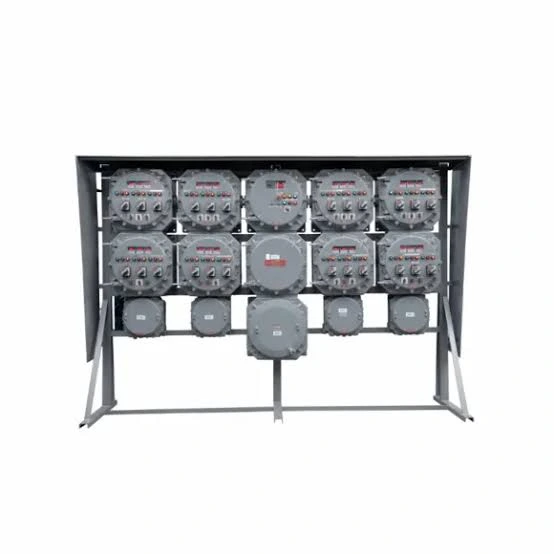
 explosion proof panel board
An explosion proof panel board is an electrical panel for applications where flammable gases, vapours, and other combustible substances create a risk of explosive atmosphere. Unlike a standard electrical panel, an explosion proof panel board is designed to control potential ignition hazards and, for protection methods such as flameproof enclosure protection, contain internal explosions to prevent them from igniting the surrounding atmosphere.
These are typically considered for hazardous industrial applications such as oil and gas, refineries, petrochemical complexes, chemical processing units, pharmaceutical manufacturing facilities, and other sites requiring specialised explosion-proof electrical equipment.
What Is an Explosion Proof Panel Board?
An explosion proof panel board is a specialised electrical enclosure for housing electrical equipment such as circuit breakers, switches, control components, terminals, and other devices in a hazardous location.
The term “explosion proof” is generally used in the industry, while the IEC 60079 framework refers to protection concepts. One of these protection concepts is Ex d, or protection by flameproof enclosure. In particular, IEC 60079-1 sets out the requirements for the construction and testing of electrical equipment for explosive gas atmospheres that use flameproof enclosures.
The aim is not just to make the panel box stronger than a standard enclosure. The enclosure construction, joints, cable entries, components, temperature characteristics, and certification need to be appropriate for the intended application in a hazardous area.
How Does an Explosion Proof Panel Board Work?
The working principle depends on the protection method used. For a flameproof Ex d design, the basic principle involves containing an internal ignition event.
If an explosive gas-air mixture enters an enclosure and an internal electrical component creates an ignition source, an explosion could occur inside the enclosure. A flameproof enclosure is designed to withstand the resulting pressure and prevent the internal explosion from propagating to the surrounding explosive atmosphere.
This protection involves several important design features:
1. Strong enclosure construction
The enclosure must be capable of withstanding the pressure generated by an internal explosion without failing in a way that allows flames to ignite the surrounding atmosphere.
2. Controlled flamepaths
The joints between enclosure components are engineered as flamepaths. These paths are designed to prevent the transmission of an internal explosion to the external atmosphere.
The dimensions and construction of flameproof joints are important parts of the Ex d protection concept.
3. Appropriate cable entries
Cables entering the enclosure require suitable cable glands or entry systems. These components must be compatible with the enclosure, cable construction, certification, and hazardous-area requirements.
4. Controlled surface temperature
Electrical equipment can produce heat during operation. The equipment therefore needs to have an appropriate temperature classification for the hazardous atmosphere in which it will be installed.
5. Suitable certified components
The electrical components installed inside a hazardous-area panel need to be selected according to the required protection concept and equipment certification.
What Are the Main Components of an Explosion Proof Panel Board?
The exact configuration varies according to the application, but a hazardous-area panel may incorporate several electrical and mechanical elements.
Enclosure
The enclosure protects the internal electrical equipment and forms an essential part of the protection system.
Circuit Protection Devices
Circuit breakers, fuses, isolators, and other protection devices can be incorporated depending on the panel’s function and electrical design.
Control Components
Contactors, relays, switches, terminals, and control devices may be included in panels designed for industrial control applications.
Cable Glands
Cable glands provide a secure cable entry into the enclosure. Their selection is particularly important in hazardous-area installations because the cable entry must maintain the required protection characteristics.
Earthing Connections
Proper earthing and bonding arrangements are essential parts of electrical installation safety and must be designed according to the applicable installation requirements.
Explosion Proof Panel Board vs Standard Electrical Panel
The main difference is the environment and protection requirements for which the equipment is designed.
A conventional electrical panel may be suitable for an ordinary industrial environment where an explosive atmosphere is not expected. It is not automatically suitable for a hazardous location.
An explosion proof panel board, by contrast, is designed or certified according to a specific hazardous-area protection concept.
The difference therefore involves much more than enclosure thickness. Hazardous-area equipment selection can involve:
- Area classification
- Protection method
- Gas or dust characteristics
- Temperature classification
- Equipment protection level
- Certification
- Cable entry requirements
- Environmental conditions
- Installation and maintenance requirements
Simply placing standard electrical components inside a stronger box does not make the resulting assembly suitable for a hazardous area.
How Do You Choose the Right Explosion Proof Panel Board?
Choosing an explosion proof panel board should begin with the requirements of the installation rather than the panel alone.
Consider the following:
- Hazardous-area classification: Determine the applicable zone or classification of the installation.
- Material present: Identify whether the hazard involves gases, vapours, dust, or other combustible substances.
- Gas or dust group: The characteristics of the hazardous substance affect equipment selection.
- Temperature class: Confirm that the equipment’s maximum surface temperature is appropriate for the application.
- Protection method: Determine whether Ex d or another protection concept is required.
- Electrical requirements: Consider voltage, current, fault levels, number of circuits, control requirements, and connected loads.
- Cable entry: Ensure the selected cable glands and accessories are compatible with the panel and its certification.
- Environmental conditions: Consider moisture, dust, corrosion, ambient temperature, outdoor exposure, and other site conditions.
- Certification: Verify that the equipment certification matches the intended application and project requirements.
These factors should be evaluated by qualified engineering and electrical professionals before equipment is specified or installed.
Why Are Explosion Proof Panel Boards Important in Hazardous Industries?
In hazardous industries, electrical equipment can potentially become an ignition source through sparks, arcs, electrical faults, or hot surfaces. Specialised hazardous-area equipment is designed to address these risks according to defined protection principles.
For an Ex d panel, the protection philosophy is based on containing a possible internal explosion and preventing flame transmission to the surrounding explosive atmosphere. This makes the enclosure design, flamepaths, components, cable entries, and certification important considerations.
FCG Flameproof Control Gears (India) Pvt. Ltd. specialises in flameproof and explosion-proof electrical solutions for hazardous industrial environments. Its product range includes flameproof electrical equipment and customised panel solutions designed for industrial applications.
For a project requiring hazardous-area electrical equipment, the right solution should be selected according to the area’s classification, equipment requirements, applicable certification, and project specifications rather than relying on a generic “explosion proof” label.
Final Thoughts
An explosion proof panel board is more than a conventional electrical panel with a reinforced enclosure. In hazardous environments, its protection depends on the complete design, including the enclosure, flamepaths, electrical components, cable entries, temperature characteristics, certification, installation, and maintenance.
Understanding the hazardous area first is therefore essential. Once the classification and operating conditions are established, the appropriate protection method and certified equipment can be selected.
For oil and gas, petrochemical, chemical, pharmaceutical, and other hazardous industrial applications, working with an experienced manufacturer can help ensure that panel requirements are evaluated against the actual conditions of the installation.
Looking for Hazardous-Area Electrical Solutions?
FCG Flameproof Control Gears (India) Pvt. Ltd. provides flameproof and explosion-proof electrical solutions for industrial applications. If you need a customised panel or hazardous-area electrical equipment, contact FCG to discuss your application and equipment requirements.
Frequently Asked Questions
1. What is an explosion proof panel board?
An explosion proof panel board is a specialised electrical panel intended for hazardous environments where flammable gases, vapours, or other explosive atmospheres may be present. Depending on its protection concept, it is designed to prevent electrical equipment from becoming an effective ignition source or to contain an internal explosion.
2. How does an explosion proof panel board work?
For an Ex d flameproof design, the enclosure is designed to withstand an internal explosion and prevent flame transmission to the surrounding explosive atmosphere. Specially engineered flamepaths are an important part of this protection.
3. Where are explosion proof panel boards used?
They are used in hazardous industrial environments such as oil and gas facilities, refineries, petrochemical plants, chemical facilities, and other locations where explosive atmospheres may occur.
4. Is an explosion proof panel board the same as a flameproof panel?
The terms are often used interchangeably in industrial conversations, but equipment should be identified by its specific protection method and certification. In the IEC 60079 framework, Ex d specifically refers to protection by flameproof enclosure.
5. What should you consider when selecting an explosion proof panel board?
Consider the hazardous-area classification, gas or dust group, temperature class, required protection method, electrical specifications, cable entry requirements, environmental conditions, and applicable certification. The final selection should match the actual conditions and requirements of the installation.