


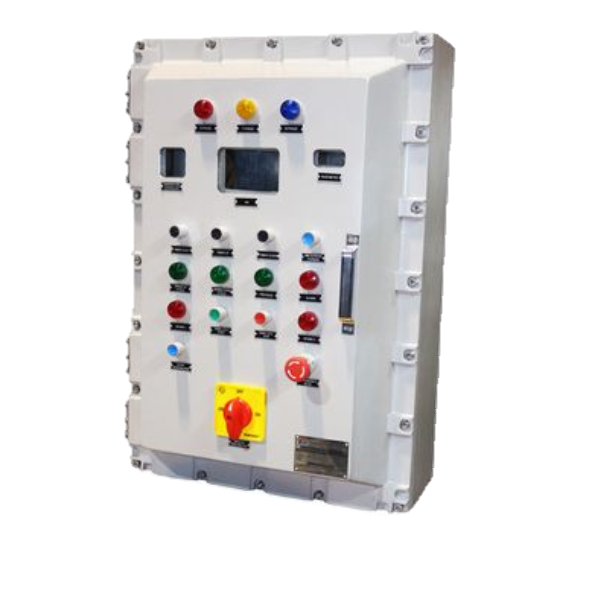
 flame proof electrical panel
Anyone who has spent time inside a refinery, a chemical plant, or a pharma manufacturing unit knows that electrical panels are everywhere. They control motors, distribute power, and keep entire process lines running.
But in areas where flammable gases, vapors, or combustible dust fill the air, an ordinary panel simply isn’t an option.
That’s where a flame proof electrical panel comes in, and once you understand the engineering behind it, it’s easy to see why plants treat it as essential rather than optional.
So, What Exactly Is a Flame Proof Electrical Panel?
A flame proof electrical panel is an enclosure built to house switches, control gear, wiring, and distribution components in a way that prevents any internal spark or arc from igniting the explosive atmosphere outside.
The panel doesn’t stop sparks from occurring inside it. Instead, if an internal spark ever ignites trapped gas, the rugged, precisely machined housing contains that explosion completely.
The resulting hot gases cool as they escape through tightly engineered flame paths, so by the time they reach the surrounding air, they no longer carry enough energy to ignite anything outside.
This is the foundation of Ex d, or flameproof, protection, and it’s why every genuine flame proof electrical panel goes through serious certification testing before it’s cleared for use in a hazardous zone.
Why Do Industries Need Electrical Panel?
Think about a petrochemical plant or a pharmaceutical API facility running around the clock. Flammable vapors, solvents, and fine combustible dust are simply part of the working environment.
A single uncontrolled spark from a standard panel is all it takes to trigger a fire or a full-scale explosion, putting equipment, production, and human lives at risk.
This is exactly why hazardous locations classified as Zone 1, Zone 2, Zone 21, or Zone 22 make a certified flame proof electrical panel mandatory for any distribution or control application.
It isn’t a premium add-on. It’s the baseline requirement for keeping a plant operational and its people safe.
Key Features That Make These Panels Reliable
A well-engineered flame proof electrical panel brings together a fairly demanding set of features. Ex d certified protection covering Zone 1, Zone 2, Zone 21, and Zone 22 areas across gas groups IIA, IIB, and IIC forms the starting point.
Pair that with an IP66 rated enclosure that shrugs off dust, moisture, and washdown conditions, and you already have something built for real plant environments rather than just a lab test. Configurations aren’t fixed either.
Switches, indicator lamps, terminal arrangements, and distribution layouts can all be customized around what the process actually needs, instead of forcing the plant to adjust around a rigid product.
Build quality has to hold up against extreme temperatures and chemical exposure for years of continuous use, and compliance with ATEX, IECEx, and IS/IEC standards means the equipment carries credibility across both Indian and international markets.
Mounting options, whether wall-mounted or free-standing, add further flexibility depending on how the facility is laid out.
Material selection plays a bigger role than most people expect. Aluminium Alloy LM6 works well for general industrial use where lightweight, corrosion-resistant construction matters. Stainless Steel 304 or 316 becomes the natural choice for marine sites or areas with heavy chemical exposure, offering excellent long-term corrosion resistance.
Cast Iron suits heavy-duty applications where sheer ruggedness outweighs the need for lighter weight. Getting this material choice right is often what separates a flame proof electrical panel that lasts a decade from one that needs constant maintenance within a couple of years.
Where Are These Panels Actually Used?
Wherever hazardous atmospheres and electrical distribution meet, you’ll find a flame proof electrical panel doing the heavy lifting. Oil & gas exploration sites, refineries, petrochemical plants, pharmaceutical API units, chemical processing facilities, and power generation plants all depend on them daily. India’s pharma and chemical manufacturing belt makes this demand particularly visible.
Ankleshwar in Gujarat, known for its dense concentration of chemical intermediates, relies heavily on flameproof distribution equipment across its units.
Vapi, another major industrial town in South Gujarat, sees similar demand across its chemical and pharma clusters.
Hyderabad, often called the Bulk Drug Capital of India, is home to over 800 pharma companies where certified hazardous-area panels are simply part of standard operating procedure.
Pithampur in Madhya Pradesh, known as the Detroit of MP, runs a dedicated pharma SEZ where compliance with flameproof standards isn’t negotiable.
Tarapur in Maharashtra remains a significant hub for small, medium, and large-scale chemical industries that depend on rugged, certified electrical infrastructure.
Across every one of these regions, the same pattern holds true: wherever flammable material is part of daily operations, a properly certified panel is working quietly in the background, keeping things safe.
Why Choose FCG Flameproof Control Gears (India) Pvt. Ltd.?
FCG Flameproof Control Gears (India) Pvt Ltd has built its name by genuinely understanding what hazardous-area operators deal with on a daily basis, not just by supplying a product that meets minimum compliance requirements.
Every flame proof electrical panel they build combines Ex d protection, IP66 resistance, and material options suited to everything from coastal humidity to aggressive chemical exposure.
What really sets them apart is how far they take customization. Rather than expecting a plant to redesign its process around a fixed product, FCG configures each panel around the exact switching, control, and distribution requirements a client actually has.
For engineers working against tight installation timelines, that flexibility translates into fewer delays and far less rework once the panel reaches site.
Conclusion
A flame proof electrical panel is one of those components that rarely gets attention until something goes seriously wrong, and by then, the damage is already done.
Choosing a certified, well-engineered panel from a manufacturer who genuinely understands hazardous areas isn’t just about satisfying an audit checklist.
It’s about protecting the people working near live electrical equipment every single day, and keeping operations running smoothly in environments where there’s almost no margin for error.
Ready to Upgrade Your Hazardous Area Electrical Systems?
If your facility operates in a Zone 1, Zone 2, Zone 21, or Zone 22 hazardous area, don’t leave electrical safety to chance.
FAQS
It doesn’t prevent sparks from occurring inside the panel. It contains any resulting explosion and cools the escaping gases so they can’t ignite the flammable atmosphere outside the enclosure.
Usually Zone 1 and Zone 2 for gas or vapor hazards, and Zone 21 and Zone 22 for combustible dust, depending on the gas group and the material present at the facility.
Look for ATEX, IECEx, and IS/IEC compliance, along with an IP66 rating for protection against dust and moisture in addition to explosion containment.
Yes. FCG configures switching, control, and distribution layouts based on the client’s process, with material choices like aluminium alloy, stainless steel, or cast iron depending on the environment.
Oil & gas, petrochemicals, pharmaceuticals, and chemical manufacturing industries are the biggest users, particularly in hubs like Ankleshwar, Vapi, Hyderabad, Pithampur, and Tarapur.